
Vocabulary: miejsca zamieszkania, dom, pokoje, meble
Dom i miejsce zamieszkania to pewny temat maturalny. Opisujesz gdzie mieszkasz, jak wygląda twój dom i co w nim jest. Suffix -ion/-tion to bonus gramatyczny tej lekcji.
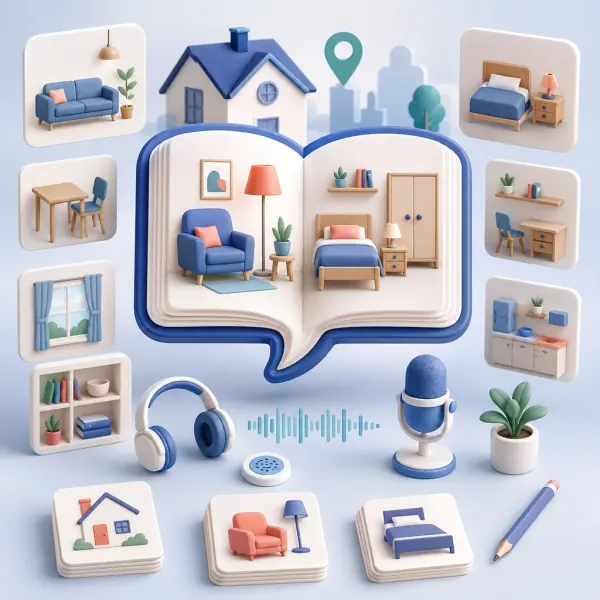
Po tej lekcji będziesz umieć
- nazwać typy domów, pomieszczenia i meble,
- opisać swój pokój prostymi zdaniami,
- używać there is / there are,
- stosować przyimki miejsca: next to, opposite, between, on, in,
- napisać lub powiedzieć krótki opis miejsca zamieszkania.
Po co opis domu na maturze?
Temat domu wraca w opisach, dialogach, ogłoszeniach i krótkich wypowiedziach. CKE zwykle nie pyta o pojedyncze słówko — sprawdza, czy umiesz użyć go w zdaniu i zrozumieć kontekst.
Słabo: My room has bed. → Dobrze: There is a bed next to the window and a desk opposite the wardrobe.
Słownictwo
Home vocabulary map
Jeden temat, kilka grup słów — z nich zbudujesz opis
Opis miejsca prowadź od ogółu do szczegółu: typ domu → pokój → meble → atmosfera i opinia.
Types of homes
I live in a flat in a block of flats. · My grandparents live in a detached house in the countryside.
Rooms and furniture
"The kitchen is small but modern."
"There is a desk next to the window."
Adjectives & atmosphere
My bedroom is cosy and bright. · The living room is spacious and comfortable.
Useful chunks — opis miejsca
Słówka muszą przejść w chunks. Te zwroty wracają w każdym opisie:
- I live in a small flat in the city centre.
- My room is quite small but cosy.
- There is a bed next to the window. · There are posters on the wall.
- next to / opposite / between / on the left / on the right
- I like it because it is quiet and comfortable.
There is / there are + przyimki
Przyimki miejsca: next to (obok) · opposite (naprzeciwko) · between (między) · on (na) · in (w).
furniture jest niepoliczalne.
liczba mnoga wymaga „are".
„next to", nie „next".
Uwaga
Before listening
- What rooms can you usually find in a flat or house?
- Name three pieces of furniture you can see in your room.
✓ Show model answers
Przykład
Listen in context — Showing a new flat
📄 Pokaż transkrypt
Słownictwo
While listening
Task A — Listen for gist
Przeczytaj pytania, a potem posłuchaj i wybierz właściwą odpowiedź.
-
What are Sophie and Adam talking about? a) Adam's school · b) Adam's new flat · c) Adam's holiday
-
What is Adam's opinion about the flat? a) He doesn't like it. · b) He thinks it is too big. · c) He likes it because it is comfortable and quiet.
✓ Check answers
Task B — Listen for rooms
Które pokoje lub miejsca Adam wymienia? Zaznacz właściwe:
- living room
- bedroom
- kitchen
- bathroom
- hall
- garden
- garage
- balcony
- dining room
✓ Check answers
Task C — Listen for furniture
Uzupełnij tabelę meblami i przedmiotami, które Adam wymienia:
| Room | Furniture / objects |
|---|---|
| Living room | … |
| Bedroom | … |
| Kitchen | … |
✓ Show model answer
Uwaga
After listening
Task D — True or false?
- 11. Adam's flat is very big.
- 22. The balcony is next to the living room.
- 33. There is a sofa opposite the TV.
- 44. Adam's bedroom is large and messy.
- 55. His desk is under the window.
- 66. There are many chairs in the kitchen.
- 77. Adam says the bathroom is a bit old.
✓ Check answers
Task E — Vocabulary focus
Znajdź angielskie odpowiedniki z nagrania:
- jasny
- przytulny
- balkon
- salon
- naprzeciwko telewizora
- przed sofą
- w rogu
- przy ścianie
- obok drzwi
- na środku kuchni
✓ Check answers
Task F — Prepositions challenge
Uzupełnij zdania właściwym przyimkiem miejsca:
- 11. There is a coffee table ______ the sofa.
- 22. There are two armchairs ______ the window.
- 33. The bookshelf is ______ the corner.
- 44. The desk is ______ the window.
- 55. The fridge is ______ the cooker and the cupboard.
✓ Check answers
Use it now — speaking
Opisz swój pokój lub mieszkanie. Powiedz lub napisz 5–6 zdań. Użyj: 2 słów o domu / pokojach · 3 mebli · 2 przyimków miejsca · 1 przymiotnika opinii. Możesz zacząć: "I live in…" / "My room is…" / "There is / There are…" / "I like it because…"
✓ Show model answer
Describe a room builder
Zbuduj opis pokoju
Od pokoju do pełnego opisu w 5 krokach
Room
jaki to pokój?
Size / atmosphere
small • cosy • bright
Furniture
a bed • a desk • a wardrobe
Position
next to • opposite • between
Opinion / reason
I like it because…
Pamiętaj: Model: My room is small but cosy. There is a desk next to the window. I like it because it is quiet.
Uwaga
Use it now: opisz swój pokój
- 1What room is it?
- 2What is it like?
- 3What furniture is there?
- 4Why do you like it?
From words to exam answer
Word → chunk → sentence → exam answer
Zamień słówko w pełną wypowiedź maturalną
Nie kończ na słówku — pokaż je w pełnym, uzasadnionym zdaniu.
Uwaga
Mini-matura
Zadanie 1 — opis miejsca (pisanie)
Describe your room in four sentences. Use: one adjective, there is / there are, one preposition of place and one reason.
Zadanie 2 — reakcja językowa (mówienie)
Your English friend is visiting you. Tell them where they can sleep and what is in the room.
✓ Pokaż modelowe odpowiedzi
Słownictwo
Kluczowe pojęcia
| Termin | Definicja |
|---|---|
| home | Dom (miejsce, gdzie mieszkasz). |
| flat | Mieszkanie. |
| house | Dom (budynek). |
| block of flats | Blok mieszkalny. |
| detached house | Dom wolnostojący. |
| semi-detached house | Dom bliźniak. |
| terraced house | Dom szeregowy. |
| room | Pokój / pomieszczenie. |
| kitchen | Kuchnia. |
| bathroom | Łazienka. |
| bedroom | Sypialnia. |
| living room | Salon / pokój dzienny. |
| furniture | Meble (niepoliczalny). |
| bed | Łóżko. |
| desk | Biurko. |
| wardrobe | Szafa (na ubrania). |
| sofa | Kanapa. |
| shelf / shelves | Półka / półki. |
| spacious | Przestronny. |
| cosy | Przytulny. |
| messy | Bałaganiarski, w nieładzie. |
| there is / there are | „jest / są" — konstrukcja opisu miejsca. |
| next to | „obok". |
| opposite | „naprzeciwko". |
| between | „pomiędzy". |
| on | „na" (na powierzchni). |
| in | „w" (wewnątrz). |
| preposition of place | Przyimek miejsca (on, in, next to…). |
| suffix -ion / -ation | Przyrostek rzeczownikowy: decorate → decoration. |
Checklist przed sprawdzianem
- Znam typy domów, pokoje i meble.
- Używam there is / there are poprawnie.
- Znam przyimki miejsca (next to, opposite, between).
- Opisuję nie tylko rzecz, ale też miejsce i opinię.
- Napiszę 4–5 zdań o swoim pokoju.
Sprawdź gotowość
Utrwal materiał i sprawdź się — wybierz następny krok
Nauka języków
modułĆwicz słownictwo, zwroty i komunikację w module Nauka języków.
Otwórz naukę językówSprawdzian
15–30 minSprawdź materiał z lekcji lub działu: vocabulary, grammar i krótkie odpowiedzi.
Zrób sprawdzianMatura próbna
pełny arkuszPrzejdź do pełnej matury próbnej z angielskiego w formacie arkusza CKE.
Otwórz maturę próbnąCzęste błędy
Częste błędy
"do opisu miejsca używaj there is/there are."
"furniture jest niepoliczalne."
"next to = obok."
"potrzebny przedimek i pełne wyrażenie."
"comfort to rzeczownik, comfortable przymiotnik."
"przymiotnik stoi przed rzeczownikiem."
✓ Pokaż więcej błędów
Źródła, format CKE i materiały ZPE
Język angielski — poziom A2/B1. Zakres: słownictwo tematyczne, kolokacje i wyrażenia, rozumienie i użycie leksyki w kontekście.
Typowe użycie: wielokrotny wybór, kolokacje, uzupełnianie luk leksykalnych, krótka wypowiedź ustna na temat zdjęcia lub sytuacji.
MATERIAŁY ZPE — INTERAKTYWNE4 materiały
Źródła: MEN — podstawa programowa języka obcego nowożytnego; CKE — informator maturalny i arkusze egzaminacyjne; ZPE — materiały interaktywne dopasowane do tematu lekcji.
W tej lekcji
LISTENING
UŻYCIE JĘZYKA
MATURA
Na końcu lekcji czeka na Ciebie: